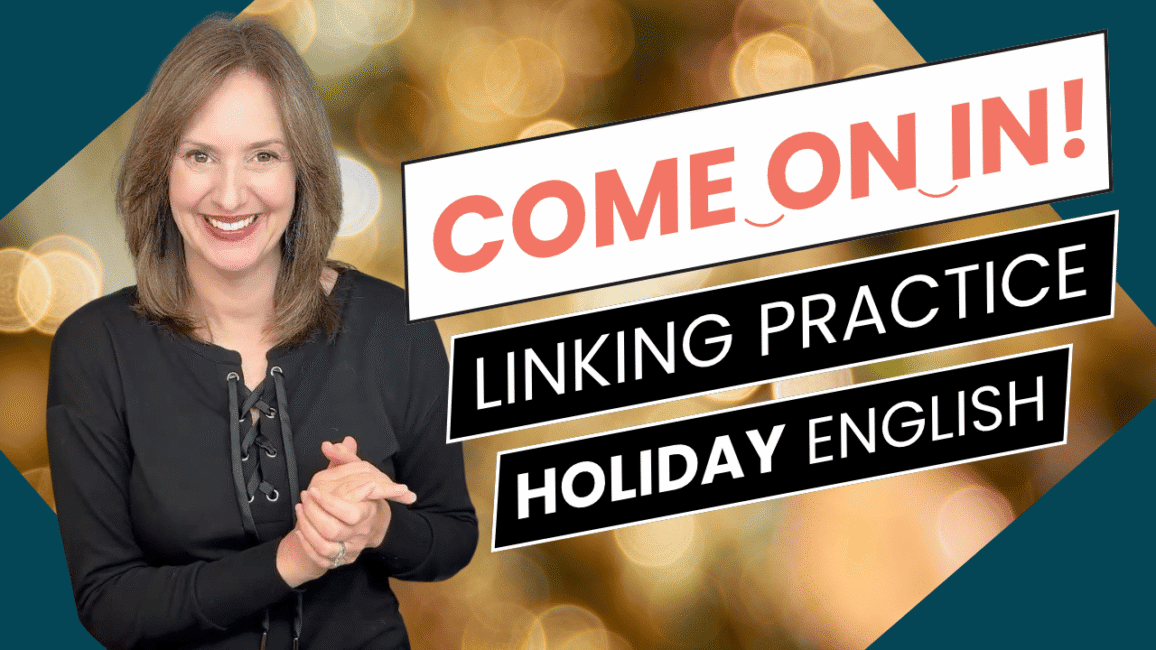
10 English Phrases for Holiday Visits: Linking Practice
You’ve accepted an invitation. You’re standing at someone’s door. Or you’re saying goodbye after a lovely evening.
You know what you want to say, but you’d like the words to come out a little more comfortably.
“Can I bring anything?”
“Come on in!”
“We should do this again!”
These little phrases help us connect with people. They also give us useful opportunities to practice linking: connecting the sounds between words in spoken English.
In this lesson, you’ll practice 10 English phrases for making plans, welcoming guests, and saying goodbye. They’re useful during the holidays—and whenever you get together with friends, family, or coworkers.
How linking helps your words flow
When one word ends in a consonant sound and the next begins with a vowel sound, that consonant can connect into the vowel.
Try:
come‿over
The /m/ at the end of “come” moves into the vowel at the beginning of “over.” You can say it slowly and still keep the connection.
We can also connect two vowel sounds. In you‿anything, you may hear a light /w/ bridge as your mouth moves from “you” into “anything.” Keep that movement gentle.
Want a fuller explanation? Explore the English Linking guide
For this lesson, we’ll focus on the marked connections. You may notice other features as you listen to my models, too. You don’t need to work on everything at once.
Making plans
1. “Do you have‿any plans?”
Use this to find out whether someone is available.
Listen for: have‿any.
Let the /v/ at the end of “have” move into the vowel at the beginning of “any.”
Picture the moment: You’d like to get together with someone. Ask whether they have any plans.
2. “You should come‿over!”
Use this to invite someone to your home.
Listen for: come‿over.
Connect the /m/ directly into “over.”
Picture the moment: Your friend is free on Saturday. Invite them over.
3. “What time should‿I come‿over?”
You’ve accepted an invitation. Now you need to know when to arrive.
Listen for: should‿I and come‿over.
Connect the /d/ in “should” into “I,” then practice the /m/ connection in “come‿over” again.
Picture the moment: You’re making arrangements with your host. Ask what time to come over.
4. “Can‿I bring anything?”
Use this to offer to contribute something to the gathering.
Listen for: can‿I.
Let the /n/ at the end of “can” connect into “I.”
Picture the moment: You’re going to someone’s home for dinner. Offer to bring something.
Arriving and visiting
5. “Come‿on‿in!”
A warm way to welcome someone at the door.
Listen for: come‿on and on‿in.
The /m/ connects into “on,” and the /n/ connects into “in.” Try the two pieces, then bring all three words together.
Picture the moment: You open the door and see someone you’re happy to welcome.
6. “Make yourself‿at home.”
This lets your guest know they’re welcome to relax and get comfortable.
Listen for: yourself‿at.
Connect the /f/ at the end of “yourself” into the vowel in “at.”
Picture the moment: You’re showing your guest into the living room. Invite them to get comfortable.
7. “Can‿I get you‿anything?”
Use this to offer your guest something, such as a drink.
Listen for: can‿I and you‿anything.
Connect the /n/ into “I.” Then listen for the light /w/ bridge between “you” and “anything.”
Picture the moment: Your guest is settled in. Ask whether they’d like anything.
Saying goodbye
8. “We’d better head‿out.”
Use this to let your host know you’re getting ready to leave. “Head out” means to leave, so this phrase helps you transition into your goodbyes.
Listen for: head‿out.
Let the /d/ at the end of “head” flow into the vowel at the beginning of “out.”
Picture the moment: It’s getting late, and you’re ready to go home. Let your host know before you thank them for the visit.
9. “Thanks for‿everything!”
Use this to show your appreciation at the end of a visit.
Listen for: for‿everything.
In American English, let the /r/ at the end of “for” connect into the vowel at the beginning of “everything.”
Picture the moment: Your host has welcomed you, prepared a meal, and made you feel at home. Thank them before you leave.
10. “We should do this‿again!”
A way to say you’d like to get together another time.
Listen for: this‿again.
Connect the /s/ at the end of “this” into the vowel at the beginning of “again.”
Picture the moment: You’ve enjoyed your time together and would like another visit.
Choose three phrases to use
You don’t need to practice all 10 at once. Choose three you could imagine using soon.
For each phrase:
- Listen to the model in the video.
- Practice the marked connection on its own.
- Say the whole phrase, picturing who you’re speaking to.
Record yourself and listen back. Can you hear the connection you practiced?
Then look for an opportunity to use one of your phrases during your next visit or gathering. A little practice now can help the words feel more comfortable when you need them.
Keep building your flow
These phrases give you a place to start. With continued practice, you can use linking across more situations and in the things you want to say.
Inside Clear English Academy, Step 3: Find Your Flow guides you through linking, reductions, and other connected speech patterns, with practice that builds toward conversation.
Membership also includes the Weekly Speaking Challenge and Questions for the Coach, so you have opportunities to use what you’re learning and ask for guidance along the way.
Explore Step 3: Find Your Flow
About Your Coach
Keenyn Rhodes is the founder of Clear English Academy and a pronunciation coach trained in speech-language pathology. For more than 15 years, she has helped global English speakers improve their American English pronunciation, rhythm, and communication skills.
Her listening-first approach combines her background in speech-language pathology with the Color Vowel® system, ear training, and guided speaking practice to help learners build clearer speech patterns they can use in real conversations.


